For ordinary use
Research a topic, compare choices, explain unfamiliar ideas, draft text and challenge your own assumptions.
AI is not one skill. It is a ladder: ask useful questions, learn to provide context, work with files, use it for coding, connect controlled tools, and eventually run models on your own hardware.
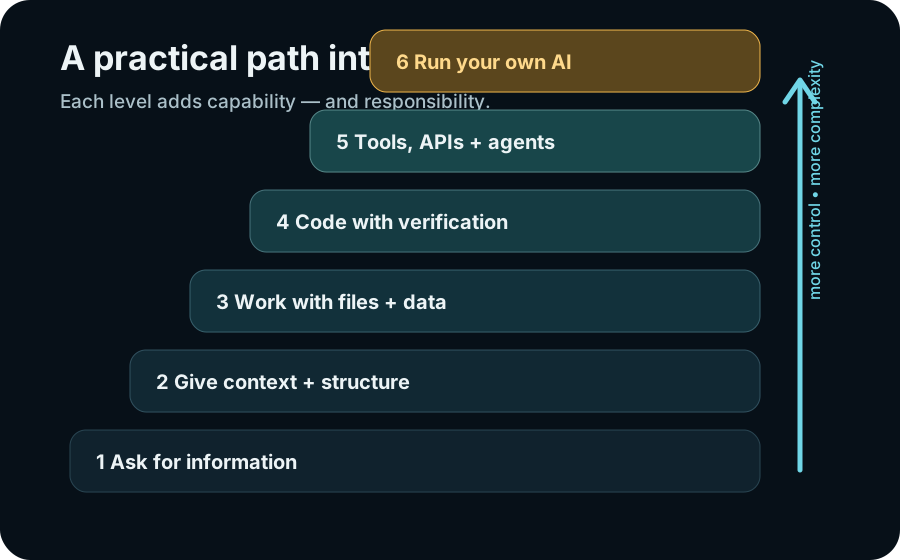
People often ask “How do I get into AI?” That question spans everything from free chatbots to software that can securely inspect selected project files. This guide separates those levels so you can learn them in a sensible order.
Research a topic, compare choices, explain unfamiliar ideas, draft text and challenge your own assumptions.
Give the AI project context, source material, constraints and a definition of what a correct result looks like.
Connect APIs and tools using authentication, least privilege, narrow interfaces, logs and verification rather than giving an AI unrestricted machine access.
Chat, explanation, comparison and research.
→2Turn vague questions into useful specifications.
→3Documents, spreadsheets, source material and bounded datasets.
→4Design, implementation, review, tests and real verification.
→5Authenticated, controlled access to real systems and directories.
→6Local models, GPU memory, runtimes, privacy and operational responsibility.
→As capability increases, so does the cost of a mistake. A weak answer to a casual question is annoying. A badly designed automated tool with write access can damage real systems. That is why the later levels emphasize controlled access, visible failures and verification.
This guide includes working principles used in the AdventureWorld project: explicit authority, enough context to reason correctly, configuration over hidden assumptions, no silent fallback, least privilege, reusable mechanisms, WHY documentation, deterministic decision paths and verifying the real product instead of merely trusting the process.
Read the AI Commandments